
MIIT Sets the Direction for Next-Generation Lithium Batteries: TOP Technology Leads the Way with Four Core Technologies!
 On June 30, at the Annual Forum of the China Automotive Power Battery Industry Innovation Alliance, Ma Chunsheng,
Director of the First Department of Equipment Industry under China’s Ministry of Industry and Information Technology (MIIT), stated: “The global new energy vehicle industry has entered a new stage of accelerated development, placing higher demands on power batteries in terms of safety, sustainability, durability, and other performance indicators. Innovation-driven development must therefore be further strengthened.”
In his remarks, Ma identified lithium-rich manganese-based cathodes, silicon-based anodes, and solid-state electrolytes as priority materials for power battery research and development. He also outlined a two-tier technology roadmap comprising high-specific-energy liquid-electrolyte lithium batteries and all-solid-state batteries. In addition, he addressed key industry issues, including low-end production capacity, supplier payment terms, solid-state battery standards, and the potential trade risks associated with low-priced exports, providing clear direction for the power battery industry to advance through innovation in frontier materials and fundamental technologies.
The high-energy-density battery industry currently faces challenges involving not only the three core battery materials—cathodes, anodes, and electrolytes—but also rapid capacity degradation during the later stages of cycling. Supported by its in-house doctoral R&D team, TOP Technology has conducted systematic research into fundamental materials, cell design, and manufacturing processes. While achieving breakthroughs in the three core material technologies, the company has also independently developed long-cycle, low-degradation technology to reduce the risk of rapid capacity “cliff drops” in later-stage cycling. The coordinated integration of the three core materials further supports improvements in cycling stability.
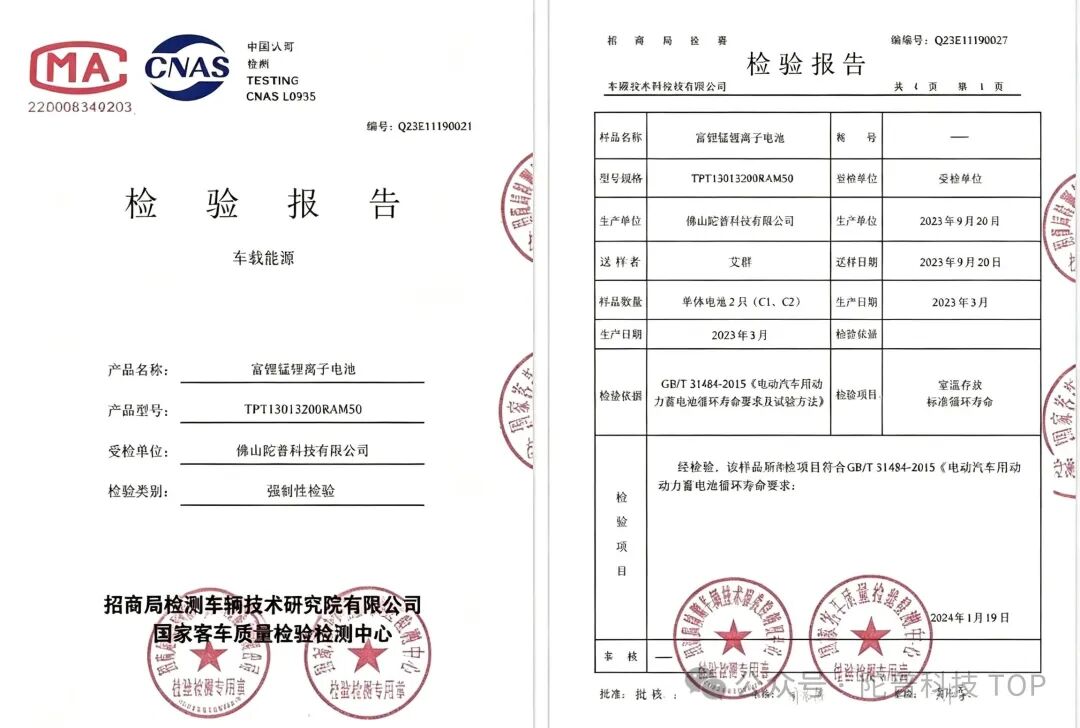
TOP Technology’s core R&D team had already accumulated extensive expertise in automotive battery technology before the industry entered its rapid-growth phase. In 2014 and 2018, the team successively completed one of China’s first mandatory automotive-grade battery tests and subsequent retesting. In 2018, it also achieved vehicle integration of lithium-rich manganese-based batteries, with the technology included in the official announcements for multiple vehicle models. Since the company was established in 2019, its technologies have continued to evolve. In 2024, TOP Technology obtained one of the world’s first mandatory automotive-grade test certifications for mass-produced lithium-rich manganese-based batteries, establishing itself as a pioneer in the commercialization of this battery chemistry.
TOP Technology has independently developed four core technologies: lithium-rich manganese-based cathodes, 100% all-silicon-carbon anodes, composite solid-state electrolytes, and long-cycle, low-degradation technology. Together, these innovations form a complete technology system spanning core materials, cell design, and manufacturing processes. The coordinated integration of the three core materials provides additional support for extended cycle life.
TOP Technology’s 460 Wh/kg high-energy-density cells have already entered batch delivery, while its 400 Wh/kg high-energy-density UAV batteries have been supplied consistently for two years. The company’s technology roadmap is highly aligned with the development of next-generation lithium batteries toward higher energy density, solid-state technology, and longer cycle life.
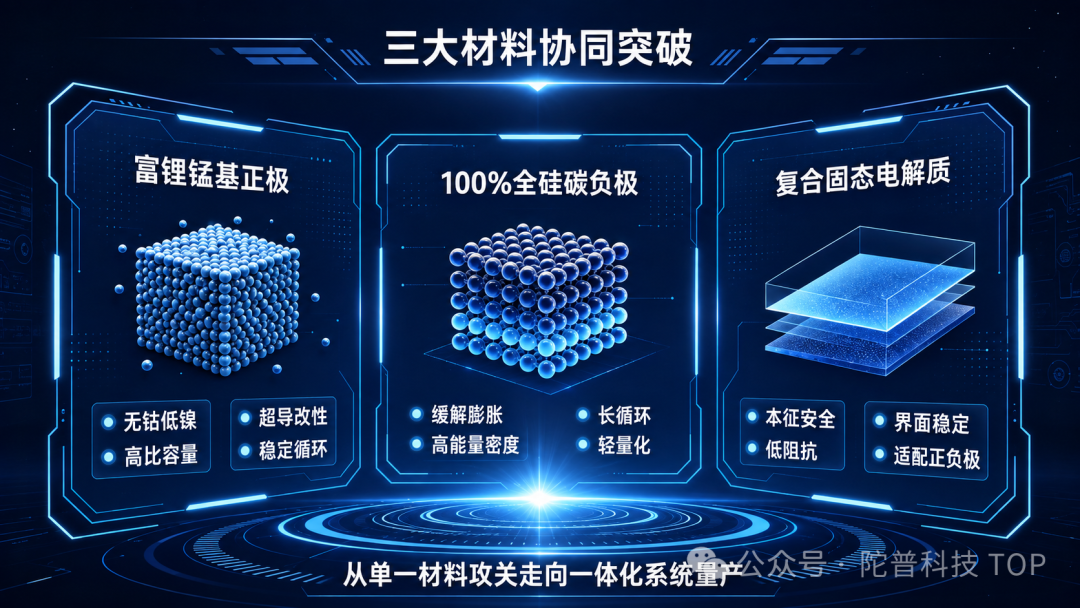
I. Coordinated Breakthroughs in Three Core Materials: Building a Long-Cycle, Low-Degradation Technology System
The high-energy-density battery industry currently faces challenges involving not only the three core materials—cathodes, anodes, and electrolytes—but also rapid capacity degradation during the later stages of cycling. Supported by its in-house doctoral R&D team, TOP Technology has pursued coordinated innovation starting from fundamental materials, establishing a complete technology chain that spans material development, cell design, and long-cycle performance management.
1. TOP Technology’s Proprietary Lithium-Rich Manganese-Based Cathode: Addressing a Two-Decade-Old Industry Challenge of Voltage Decay
Current industry challenges: With an ultra-high specific capacity of 320 mAh/g, cobalt-free chemistry, and cost advantages, lithium-rich manganese-based material has been identified by MIIT as a priority high-capacity cathode material. However, its commercialization has long been constrained by cycling degradation, low initial coulombic efficiency, and other technical limitations. Most industry peers have progressed only to pilot production at the hundred-tonne scale and do not plan to commission thousand-tonne production lines until 2027, making stable near-term vehicle integration difficult.
TOP Technology’s Core Proprietary Advantages
Proprietary cobalt-free, low-nickel formulation: With a nickel content of only 25%–35%, the formulation substantially reduces exposure to fluctuations in overseas cobalt and nickel prices. This enables long-term cost control and supports applications ranging from automotive batteries to UAVs.
Patented superconductive powder-modification process: Led by founder Dr. Chen Guangsen, TOP Technology has developed a proprietary doping and coating technology that suppresses voltage decay at the crystal-structure level. Its cycling stability is comparable to that of premium ternary cathode materials, and the related patent application has entered substantive examination.
Inherently compatible with solid-state battery systems: Unlike conventional products designed primarily for liquid electrolytes, TOP Technology’s proprietary solid–solid interfacial conduction structure significantly reduces contact resistance between the cathode material and composite solid-state electrolytes.
Years of automotive-grade mass-production validation: The team obtained its first automotive-grade mandatory test report in 2014 and passed automotive-grade recertification in 2018. Its lithium-rich manganese-based batteries were subsequently included in the official announcements for four vehicle models. TOP Technology was also among the first companies worldwide to obtain China’s national mandatory certification for lithium-rich manganese-based solid-state batteries and has entered into a joint R&D partnership with FAW Group.
2. TOP Technology’s 100% All-Silicon-Carbon Anode: Breaking Through the Energy-Density Ceiling of Low-Silicon Solutions
Current industry challenges: Graphite anodes have nearly reached their theoretical capacity limit. Silicon is the only anode material capable of substantially increasing battery endurance and has been identified by MIIT as a key near-term pathway for improving energy density. However, silicon can undergo volume expansion of up to 300% during charging and discharging, making electrode pulverization highly likely. Leading battery manufacturers have therefore adopted conservative formulations containing less than 10% silicon, while high-silicon samples typically deliver fewer than 200 cycles—insufficient for the long-term operating requirements of premium equipment.
TOP Technology’s Core Proprietary Advantages
A rare mass-production process for 100% all-silicon-carbon anodes: TOP Technology achieved the practical implementation of its all-silicon-carbon anode technology as early as 2024. Its proprietary in-situ solid-electrolyte coating technology effectively accommodates expansion and deformation during charging and discharging, preventing disruption of the conductive network.
Cycle life significantly ahead of comparable solutions: The standalone anode delivers 700 stable cycles. When combined with TOP Technology’s proprietary lithium-rich manganese-based cathode, the complete cell achieves more than 500 cycles, substantially outperforming high-silicon samples currently available on the market.
Maximizing the energy-density potential of battery cells: With almost no conventional graphite added, mass-produced cells consistently achieve an energy density of 460 Wh/kg, while the next-stage laboratory target is 600 Wh/kg.
Dedicated production line for stacked-cell manufacturing: TOP Technology’s proprietary 0.2 GWh cell pilot line is fully compatible with its all-silicon-carbon system. The stacking process avoids lithium-plating risks associated with conventional winding processes and meets the critical lightweight requirements of UAV applications.
3. TOP Technology’s Composite Solid-State Electrolyte: Avoiding the Critical Limitations of Sulfide-Based Solid-State Systems
Current industry challenges: Solid-state electrolytes have been identified by MIIT as a strategic focus for long-term technological development. However, today’s mainstream sulfide-based approach faces three major limitations: costs are six to eight times those of liquid electrolytes, mass-production yields remain below 50%, and contact with water can release toxic hydrogen sulfide. Industry experts have also publicly stated that large-scale vehicle deployment of all-solid-state batteries is not yet practical within the next two years. The industry generally expects the technology to establish a foundation for commercialization after 2028.
TOP Technology’s Core Proprietary Advantages
A safe composite system without sulfide-related risks: TOP Technology has independently developed an oxide–polymer composite solid-state electrolyte. Cells remain free from fire for two hours following nail penetration, with no risk of releasing toxic gases upon contact with water.
Seamless compatibility with proprietary cathode and anode systems: The entire material system has been developed in parallel, eliminating the need for separate adjustments to cathode and anode formulations and substantially reducing production-line conversion costs.
Phased commercialization aligned with national standards: With China’s national standard for solid-state batteries taking effect on July 1, TOP Technology aims to reduce the liquid content of its cells to 5% or less by the end of 2026. Its current semi-solid-state products are already being supplied in large volumes.
Controllable mass-production yields with a viable foundation for profitability: Supported by a complete intelligent PACK production line, TOP Technology achieves solid-state cell production yields significantly above the industry average, enabling it to accept and profitably fulfil large-scale orders at the current stage.
4. Long-Cycle, Low-Degradation Technology: Addressing the Late-Cycle Capacity “Cliff Drop” in High-Energy-Density Cells
Current industry challenges: High-energy-density cells may maintain strong capacity performance during the early stages of cycling. However, as the cycle count increases, changes in material structure, anode expansion, and rising interfacial resistance gradually accumulate, potentially causing a rapid decline in capacity—commonly referred to in the industry as a late-cycle capacity “cliff drop.” High initial energy density therefore does not necessarily guarantee stable performance throughout a cell’s service life.
TOP Technology’s approach: TOP Technology has systematically optimized material formulations, cell structures, interfacial regulation, and manufacturing processes to develop its proprietary long-cycle, low-degradation technology. This technology enables cells to maintain a more stable capacity-retention profile throughout cycling and reduces the risk of a rapid capacity “cliff drop” in later-stage use. Its proprietary lithium-rich manganese-based cathode, 100% all-silicon-carbon anode, and composite solid-state electrolyte also work together to further enhance cycling performance.
TOP Technology’s Core Technical Advantages
Multidimensional system optimization: Material formulations, cell structures, interfacial regulation, and manufacturing processes are systematically designed to improve overall cycling stability across multiple stages.
Slower capacity degradation: Key factors affecting capacity retention are optimized to address the rapid capacity decline commonly experienced by high-energy-density cells during later-stage cycling, resulting in a more gradual and stable degradation profile.
Controlled internal-resistance growth: Interfacial regulation and process optimization slow the increase in internal resistance during cycling, reducing the risk of performance degradation caused by a rapid rise in resistance.
Improved production consistency: Critical manufacturing processes—including material mixing, coating, calendaring, stacking, electrolyte filling, and formation—are strictly controlled to minimize the effect of manufacturing variations on cycle life.
Synergistic support from three core materials: The coordinated integration of the lithium-rich manganese-based cathode, 100% all-silicon-carbon anode, and composite solid-state electrolyte provides material-level support for further improvements in long-cycle performance.
II. Beyond Laboratory Innovation: TOP Technology’s Comprehensive Industrialization Capabilities
As a Guangdong High-Tech Enterprise, TOP Technology goes beyond concept-stage research. The company transforms its advanced material technologies into production capacity, commercial orders, and real-world customer applications, establishing a complete closed-loop system from material development to final product delivery.
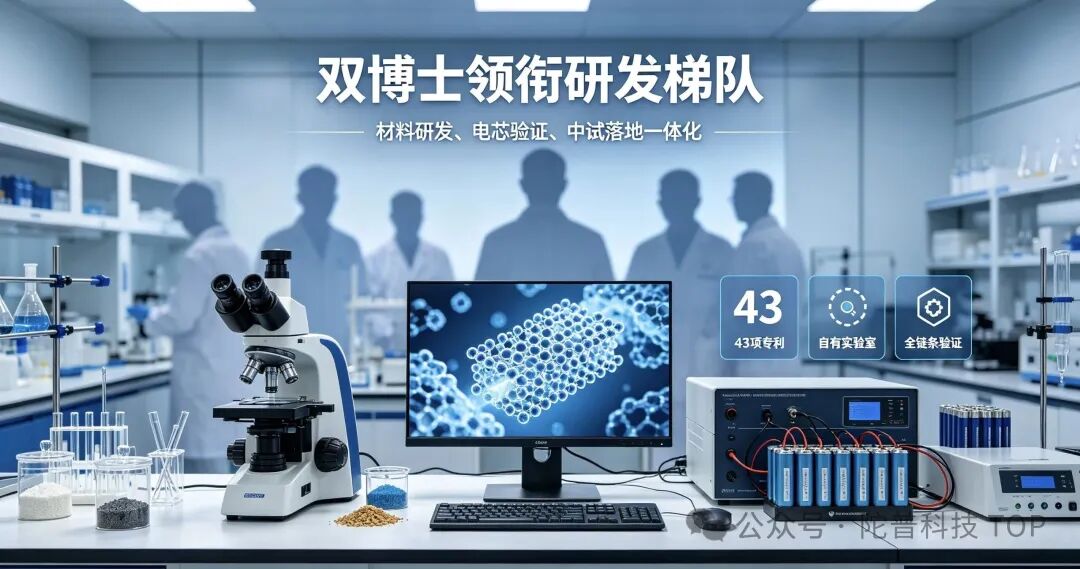
1. Dual-PhD-Led R&D Team Establishes Strong Core Technology Barriers
TOP Technology’s ability to achieve simultaneous breakthroughs in three critical battery materials is underpinned by an R&D team led by two distinguished industry experts with doctoral degrees. Together, they have established a dual-engine innovation structure combining industrial commercialization with advanced material development.
Founder & CEO: Dr. Chen Guangsen
Dr. Chen is a veteran pioneer of China’s polymer lithium-ion battery industry, with more than 30 years of international and domestic experience in lithium battery R&D, commercialization, and industrial management. He previously led the commercialization of one of the world’s first mass-produced lithium-rich manganese-based batteries.
After founding TOP Technology in 2019, Dr. Chen led the company’s efforts to address the long-standing challenge of voltage decay in lithium-rich manganese-based materials. He also established a long-term material technology roadmap aligned with MIIT’s strategic direction. Under his leadership, the team completed two rounds of mandatory automotive-grade testing in 2014 and 2018, secured official announcements for four vehicle models, and obtained other national automotive-grade certifications.
Director of the Research Institute: Dr. Zhou Xigen
Dr. Zhou holds a PhD in Materials Science from Australia and is recognized as a high-level recruited professional. He has spent 12 years specializing in silicon-carbon materials and solid-state electrolytes and holds more than ten material-related invention patents.
Since joining TOP Technology, Dr. Zhou has assumed full responsibility for developing the company’s 100% all-silicon-carbon anode and composite solid-state electrolyte processes. In 2024, he successfully brought the all-silicon-carbon anode technology into practical implementation. He also established the company’s in-house materials laboratory and led efforts to overcome key technical bottlenecks, including silicon expansion and solid–solid interfacial resistance, supporting the mass production of 460 Wh/kg high-energy-density cells.
The other core members of TOP Technology’s team each have more than 15 years of experience across the lithium battery value chain. The company holds multiple patents related to its three core materials and has established a comprehensive in-house materials R&D laboratory equipped with powder-synthesis, sintering, and full-spectrum material-characterization systems. These capabilities enable independent material development and full-process cell validation.
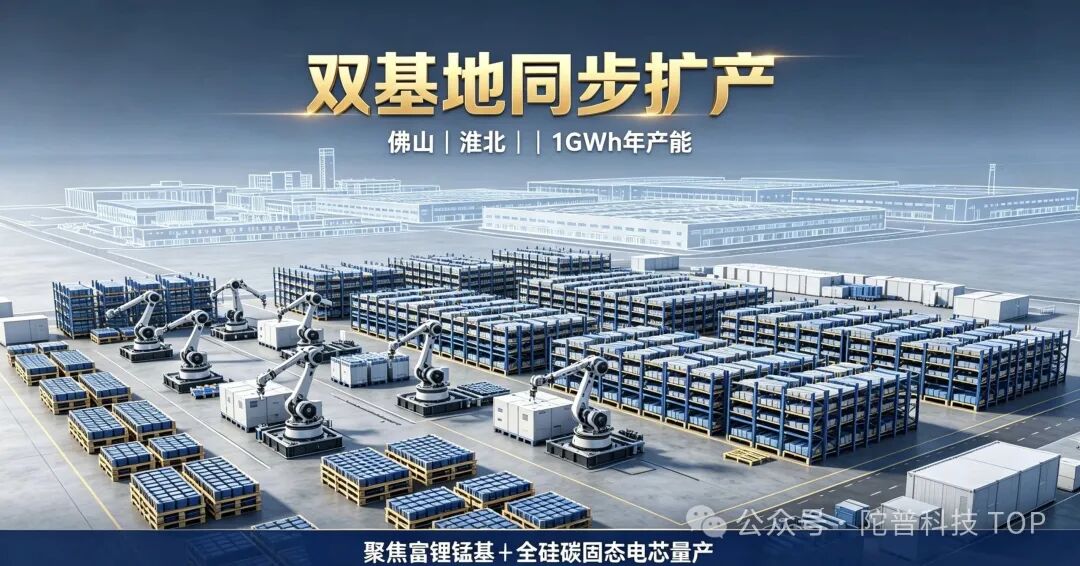
2. Simultaneous Capacity Expansion at Two Production Bases
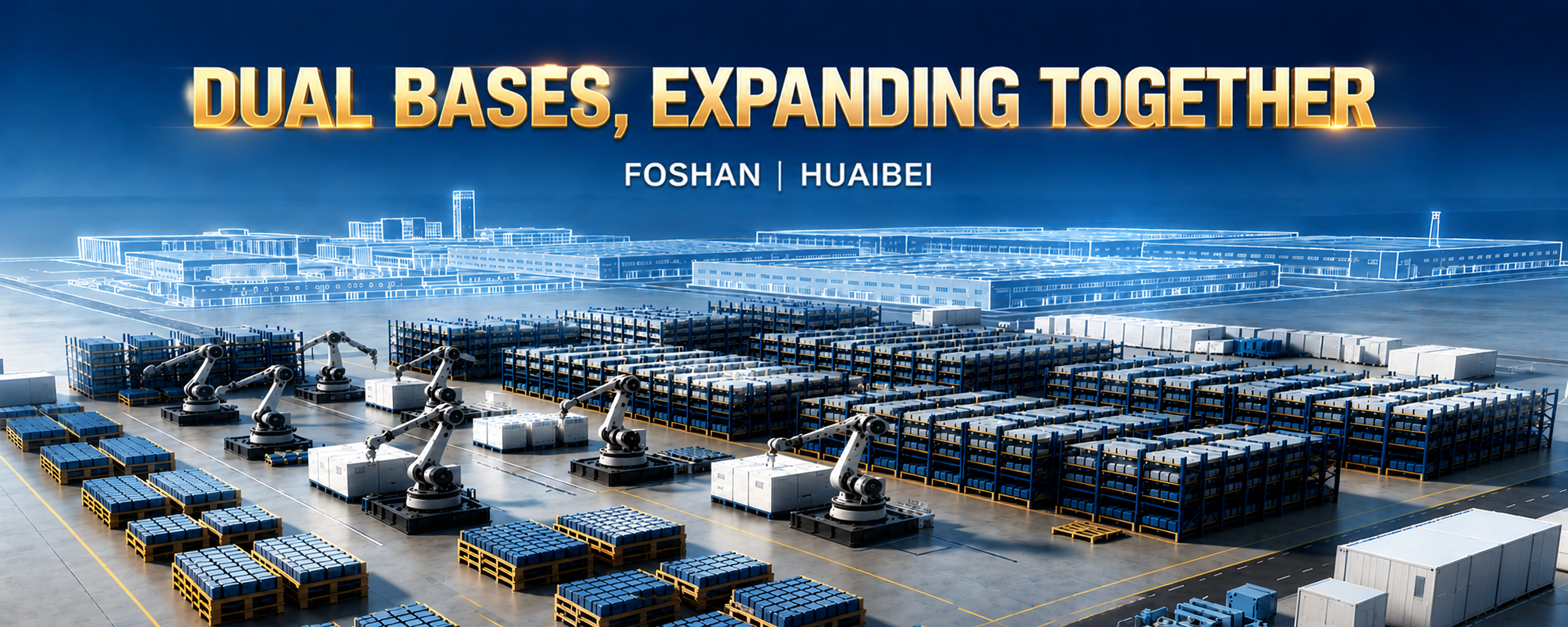
TOP Technology is simultaneously expanding its two intelligent manufacturing bases in Foshan and Huaibei, both dedicated to producing solid-state cells incorporating lithium-rich manganese-based cathodes and all-silicon-carbon anodes.
Both facilities are equipped with comprehensive intelligent and automated production systems, enabling rigorous control across the entire manufacturing process—from raw-material preparation to finished-cell inspection. The two bases focus on the development and mass production of cells based on advanced lithium battery materials, continuously strengthening TOP Technology’s capabilities in high-energy-density solid-state battery products.
Lithium Battery Materials and High-Energy-Density Solid-State Batteries
3. Large-Scale Deployment Across Multiple Premium Sectors Validates the Technology’s Market Value
TOP Technology’s high-energy-density solid-state batteries have been deployed across a range of premium applications, including UAVs, eVTOL aircraft, high-speed electric motorcycles, embodied-intelligence robots, energy storage systems, new energy vehicles, and premium power banks. Its customers include leading companies from multiple industries.
Under specific product configurations and testing conditions, batteries incorporating TOP Technology’s proprietary material system can deliver a 146% increase in operating endurance at the same volume while reducing total equipment weight by nearly 50%. These differentiated performance advantages enable the company to expand into premium international markets and mitigate the impact of low-price competition and international trade friction.
III. Clarifying Three Common Industry Misconceptions: Why TOP Technology’s Roadmap Offers a Strong Long-Term Solution
Misconception 1: Lithium-rich manganese-based materials, silicon-carbon anodes, and solid-state batteries cannot be commercialized in the near term.
Clarification: MIIT has proposed a phased approach to industrialization: large-scale application of silicon-based materials by 2026, expansion of thousand-tonne production lines for lithium-rich manganese-based materials by 2027, and continued development of all-solid-state batteries as a medium- to long-term objective.
Most industry peers focus on isolated R&D involving only one type of material, resulting in relatively long commercialization cycles. TOP Technology completed automotive-grade testing and vehicle integration of lithium-rich manganese-based batteries several years ago and achieved the practical implementation of its all-silicon-carbon anode technology in 2024.
Today, its two doctoral-level R&D leaders oversee the development of the three core materials and advance their coordinated integration. By combining the near-term commercialization of high-energy-density semi-solid-state products with the long-term development of all-solid-state technology, TOP Technology maintains a balance between current commercial operations and sustainable long-term growth.
Misconception 2: Low-silicon-carbon anodes are sufficient, making the development of 100% all-silicon-carbon anodes unnecessary.
Clarification: Government policy encourages continued breakthroughs in cell energy density. Compared with conventional energy storage systems and passenger vehicles, premium applications such as UAVs and embodied-intelligence robots impose much stricter requirements on battery weight.
Led by Dr. Zhou Xigen and brought into practical implementation in 2024, TOP Technology’s 100% all-silicon-carbon anode is better positioned to meet the premium market’s demand for higher energy density and lighter battery systems.
Misconception 3: Solid-state batteries will rapidly replace liquid-electrolyte batteries, making continued investment in high-specific-energy liquid-electrolyte batteries unnecessary.
Clarification: MIIT has objectively assessed the multiple challenges facing the industrialization of solid-state batteries. Sulfide-based solid-state electrolytes still present several critical technical issues that must be resolved.
Dr. Chen Guangsen has therefore established a dual-track technology roadmap: maintaining stable supply through mature semi-solid-state products while continuously advancing low-liquid-content solid-state battery technology that complies with national standards. This approach balances near-term commercial performance with long-term technology development.
IV. Advancing with the Industry: TOP Technology’s Development Strategy Aligns with the Transition toward High-Quality Growth
The lithium battery industry is moving away from low-price competition and toward fundamental material innovation and the rational deployment of production capacity—an evolution closely aligned with MIIT’s direction for industrial development.
Rather than pursuing indiscriminate expansion of low-end capacity, TOP Technology focuses its existing production lines on three advanced materials and related high-value-added products. Through proprietary material technologies, the company is building differentiated competitive advantages, expanding into premium domestic and international markets, reducing the impact of disorderly competition and international trade friction, and promoting high-quality, sustainable growth.
Conclusion
Competition in the lithium battery industry has fundamentally shifted from a race for production scale to a contest of core technological capabilities in cathode materials, anode materials, and electrolytes. By identifying lithium-rich manganese-based cathodes, silicon-based anodes, and solid-state electrolytes as three priority areas for technological development, MIIT has established a clear direction for industry upgrading over the coming years.
Unlike companies that focus on isolated research projects or concept-driven promotion, TOP Technology aligned itself with China’s national technology roadmap years in advance. The team completed two rounds of mandatory automotive-grade testing in 2014 and 2018, secured official announcements for four vehicle models incorporating its lithium-rich manganese-based batteries, and achieved the practical implementation of its all-silicon-carbon anode technology in 2024.
Led by Dr. Chen Guangsen and Dr. Zhou Xigen, TOP Technology’s specialist R&D team has established an integrated technology system combining lithium-rich manganese-based cathodes, 100% all-silicon-carbon anodes, and composite solid-state electrolytes. Building on the coordinated integration of these three core materials, the company has also developed long-cycle, low-degradation technology that effectively reduces the risk of a late-cycle capacity “cliff drop” in high-energy-density cells.
With an advanced R&D team, comprehensive in-house intelligent production lines, and high-volume orders across premium applications, TOP Technology is demonstrating its capabilities through tangible mass-production achievements and establishing a leading position in the next-generation power battery market.
Through the systematic optimization of material formulations, cell structures, interfacial regulation, and manufacturing processes, TOP Technology’s independently developed long-cycle, low-degradation technology further reduces the risk of rapid capacity decline during later-stage cycling. The coordinated integration of its three core materials also provides additional support for improved cycling stability.
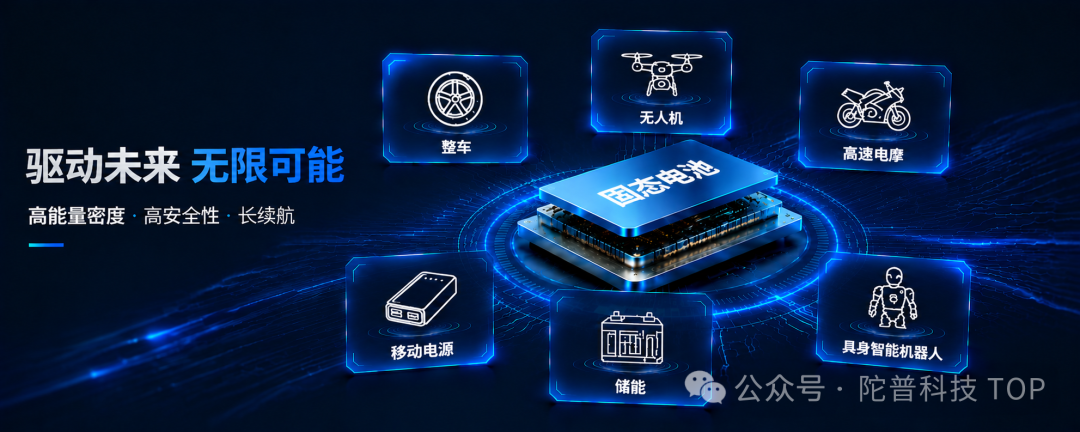
Looking ahead, TOP Technology will continue to advance integrated high-energy-density solid-state power battery solutions and refine its processes for the three core materials. The company will provide high-performance, high-safety customized battery products for customers across the new energy vehicle, high-speed electric motorcycle, UAV, energy storage, embodied-intelligence robotics, and premium power bank industries.
Follow TOP Technology for ongoing insights into the commercialization of lithium-rich manganese-based cathodes, 100% all-silicon-carbon anodes, and composite solid-state electrolytes—and contact us for a customized high-energy-density battery solution.